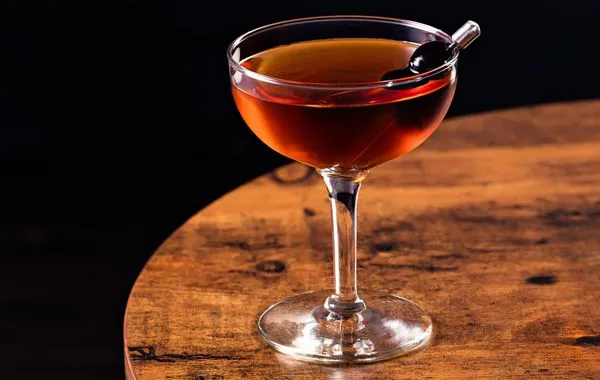
Manhattan Cocktail
- Deadly
- bitter
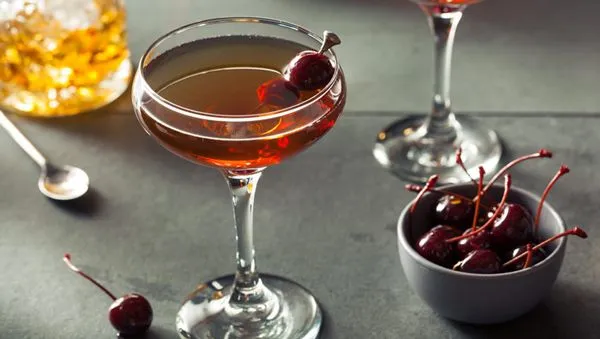
A bitter, seriously strong cocktail, stirred until cold, served in a coupe glass.
Serve in: coupe glass
Ingredients
- 2 ozbourbon
- 1 ozsweet vermouth
- 2 dashangostura bitters
- 1 dashorange bitters
- 1cherriesoptional
- Ice cubesoptional
How to Make a Manhattan
Instructions
- Add all the ingredients into a mixing glass with ice, and stir until well-chilled.
- Strain into a chilled coupe.
Garnish
Decorate with a cherry.
Tips & substitutions
- Keep your sweet vermouth in the fridge, tightly closed, and finish the bottle within a month or so; oxidised vermouth is the single most common cause of a dull, stewed-tasting Manhattan. Stir with plenty of ice and strain into a properly chilled glass, since the drink has no citrus to hide behind.
- No bourbon? Try whisky or scotch.
The glass
Serve this one in a coupe glass. Also known as Champagne Coupe or Champagne saucer. Fancy looking glass invented in the mid 17th century in England.
Did you know
The Manhattan is the drink that taught American bartenders what vermouth was for, and it arrived in the early 1880s when vermouth was still an exotic import. The most-repeated origin story has it created at a banquet at the Manhattan Club in New York, thrown by Lady Randolph Churchill, Winston's mother, and mixed by a Dr. Iain Marshall. It is a lovely story and almost certainly untrue: Jennie Churchill was in England at the relevant time, pregnant with Winston, and the tale seems to have attached itself to the drink decades later.
The more sober account comes from William F. Mulhall, a long-serving bartender at New York's Hoffman House, who recalled a man known as Black running a bar on Broadway in the 1860s where the drink was popular. That too is a memoir rather than a document. What is verifiable is that printed Manhattan recipes appear in the early to mid-1880s, including in newspapers of 1882 and in Harry Johnson's bartending manual of 1884, which puts its invention somewhere just before that.
Originally it was a rye drink, and rye remains the classic choice: its pepper and dryness cut through sweet vermouth in a way bourbon's rounder sweetness does not. Prohibition sent American drinkers toward smuggled Canadian whisky, and the post-war decades pushed bourbon forward, so all three now have legitimate claims to the glass.
The Manhattan is also the parent of an entire family. Use Scotch and you have a Rob Roy. Split the vermouth between sweet and dry and it becomes a Perfect Manhattan. Replace the vermouth with amaro and you get a Black Manhattan; add maraschino and dry vermouth in Brooklyn proportions and you get the Brooklyn. Even the Martini's early ancestor, the Martinez, sits on the same branch of the family tree.
More than any other classic, the Manhattan rewards good vermouth. It is roughly a third of the drink by volume, it is a wine, and it oxidises. A great bottle of rye poured over vermouth that has been open on a shelf since last summer makes a mediocre Manhattan every time.