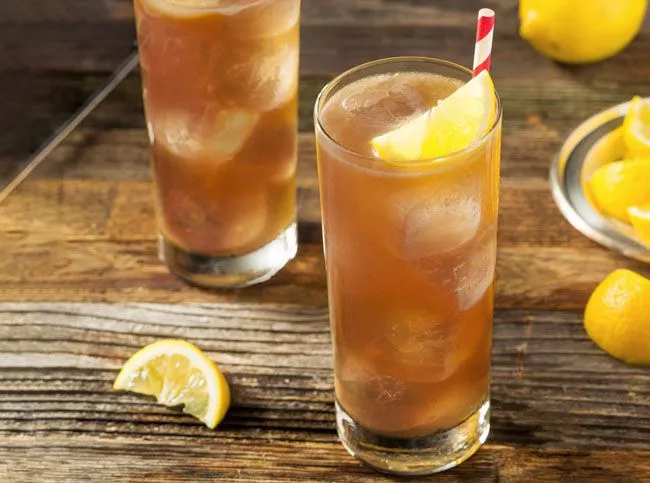
Long Island Iced Tea
- Medium
A medium-strength cocktail, shaken over ice, served in a collins glass.
Serve in: collins glass
Ingredients
- 0.5 ozwhite rum
- 0.5 ozgin
- 0.5 ozvodka
- 0.5 oztriple sec
- 0.5 oztequila
- 0.5 ozlemon juice
- 0.5 ozlime juice
- 0.5 ozrich syrup
- 2 ozcoca-cola
- 1lemon sliceoptional
- iceoptional
How to Make a Long Island Iced Tea
Instructions
- Add ice in a cocktail shaker.
- Pour rum, vodka, gin, tequila, triple sec, lime and lemon juice, and simple syrup.
- Shake well and pour into an ice filled glass.
- Top with Cola.
Garnish
Decorate with a lemon slice.
Tips & substitutions
- Measure every spirit; free-pouring five different bottles is how this drink earned its reputation, and the balance falls apart quickly if any one of them runs long. Use the cola only as a top, about an ounce or two, and let the fresh lemon and lime do the real work.
- No gin? Try vodka, tequila or white rum.
- No vodka? Try gin.
- No triple sec? Try orange liqueur, orange curacao liqueur or bitter orange liqueur.
The glass
Serve this one in a collins glass. A collins glass is a glass tumbler which typically is used to serve mixed drinks, especially Tom Collins or John Collins cocktails. It is cylindrical in shape and narrower and taller than a highball glass.
Did you know
The Long Island Iced Tea is the drink everyone underestimates. Five spirits, citrus, a little sugar and a splash of cola produce something that genuinely resembles iced tea in colour and, more surprisingly, is drinkable rather than chaotic. The trick is that each spirit appears in a small enough measure that none dominates, and the lemon, lime and cola bind them into a single flavour.
Two origin claims compete, and they are separated by half a century. Robert Rosebud Butt has long claimed to have invented the drink in 1972 at the Oak Beach Inn on Long Island, New York, as an entry in a bartending contest, and this is the account that matches the drink's documented rise through the 1970s and 1980s. A rival claim comes from a community called Long Island in Kingsport, Tennessee, where a man remembered as Old Man Bishop is said to have made a similar multi-spirit mixture during Prohibition, when disguising the taste and appearance of illicit liquor had obvious appeal. The Tennessee story is charming and locally documented in oral history, but the New York claim is the one with a traceable path to the drink's popularity.
Its reputation has suffered from decades of being made carelessly, poured free-hand and topped with far more cola than the recipe wants. Made to specification it is closer to a well-constructed sour than to a dare, with the cola contributing colour and a caramel note rather than sweetness.
The formula spawned a whole family of colour-swapped variants: the Long Beach with cranberry in place of cola, the Tokyo Tea with melon liqueur, the Electric Iced Tea with blue curacao, and various others that change the top-up and leave the spirit base alone. All of them share the same structural insight, which is that a small pour of many spirits behaves quite differently from a large pour of one.