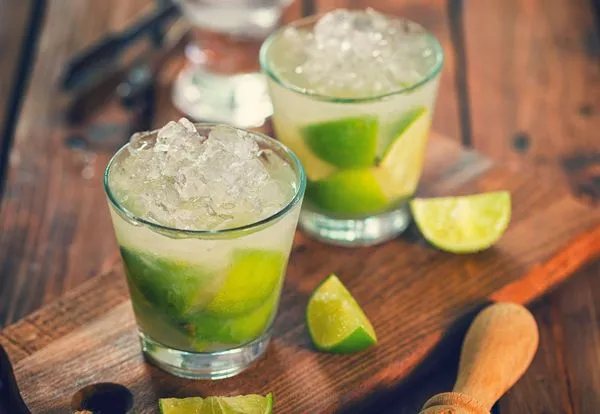
Caipirinha Cocktail
- Deadly
- sweet
- citrus
A sweet and citrus, seriously strong cocktail, shaken over ice, served in an old fashioned glass.
Serve in: old fashioned glass
Ingredients
- 2 ozcachaca
- 1 tsppowdered sugar
- 0.5limes
- 1lime wheeloptional
- Ice cubesoptional
How to Make a Caipirinha
Instructions
- Cut half of a lime into small wedges.
- Place the lime and sugar into an old-fashioned glass and muddle well.
- Add a few ice cubes.
- Top the drink with cachaça and stir well.
Garnish
Decorate with a lime wheel.
Tips & substitutions
- Cut the lime into wedges, trim out the white central pith, and muddle firmly but briefly with the sugar; you want peel oil, not crushed pith, which turns the drink bitter. Use granulated or caster sugar rather than syrup, since the sugar crystals do part of the work of abrading the peel.
- No cachaca? Try white rum.
- No limes? Try lemons.
The glass
Serve this one in an old fashioned glass. The old fashioned glass or rocks glass is a short tumbler used for serving spirits, such as whisky, neat or with ice cubes. It is also normally used to serve certain cocktails, such as the Old Fashioned, from which it receives its name.
Did you know
The Caipirinha is Brazil's national cocktail and one of the few drinks defined in law. Its base spirit, cachaca, is distilled from fresh-pressed sugarcane juice rather than the molasses used for most rum, which gives it a grassy, vegetal, sometimes funky character that no rum quite reproduces. Brazilian regulation formally defines cachaca, and the Caipirinha has an official legal specification too, as cachaca, lime and sugar.
The name comes from caipira, a word for a rural or backcountry person, roughly the Brazilian equivalent of calling something a country drink. Its history before the twentieth century is folk history rather than documented history: sugarcane spirit, limes and sugar have coexisted in Brazil since the colonial period, and some version of this combination has surely been drunk for centuries.
One widely repeated story places its modern form in the sugarcane region of Sao Paulo state around 1918, as a remedy for the Spanish flu made with lime, garlic and honey, with the garlic and honey later abandoned and the cachaca and sugar promoted. The story appears in many accounts but is not well supported by contemporary evidence, so it is best passed along as tradition rather than fact.
What is certain is the drink's international breakout, which came late. Cachaca was little known outside Brazil until export rules and marketing pushed it abroad from the 1990s onward, and the Caipirinha rode that wave onto menus worldwide.
The technique matters more than the ingredients. Muddling lime wedges with sugar extracts oil from the peel as well as juice from the flesh, which is what gives the drink its distinctive perfumed bitterness. Over-muddle and you get the pith's harshness instead. Variations follow the same method with different spirits: a Caipiroska uses vodka, a Caipirissima uses rum, and neither is a Caipirinha in the legal sense.