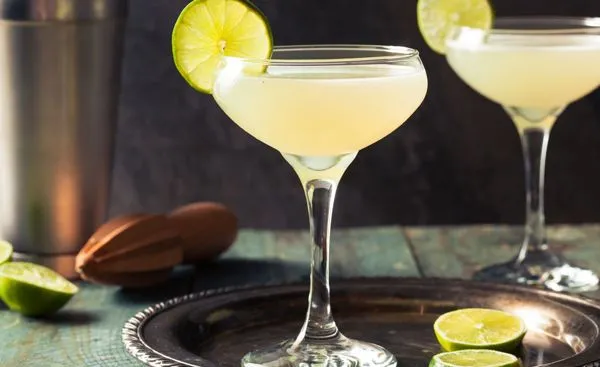
Daiquiri
- Strong
- sweet
- sour
- citrus
A sweet, sour and citrus, strong cocktail, shaken over ice, served in a coupe glass.
Serve in: coupe glass
Ingredients
- 2 ozrum
- 1 ozFreshly squeezed lime juice
- 0.5 ozsimple syrup
- Ice cubesoptional
How to Make a Daiquiri
Instructions
- In cocktail shaker filled with ice, combine rum, lime juice, and simple syrup.
- Shake vigorously, then strain into the glass.
Garnish
Decorate with lime wheel.
Tips & substitutions
- Squeeze the limes the same day you drink it, and taste before you strain, since limes vary enormously in acidity and a fixed sugar measure will sometimes be wrong. Shake hard and briefly with cold, solid ice: this drink wants to be freezing and bright, not watery.
- No rum? Try gin.
- No limes? Try lemons.
The glass
Serve this one in a coupe glass. Also known as Champagne Coupe or Champagne saucer. Fancy looking glass invented in the mid 17th century in England.
Did you know
The Daiquiri is the purest expression of the sour formula: good rum, fresh lime, a little sugar, nothing to hide behind. Its name comes from Daiquiri, a village and iron-mining area near Santiago de Cuba, and the drink is traditionally credited to Jennings Cox, an American engineer working the mines around 1898, who is said to have mixed local rum with lime and sugar for guests. Cox's notebook recipe is often cited, which makes this one of the better-evidenced origin stories among the classics, even if the drink itself was surely being poured in some form long before anyone wrote it down.
Its route into American drinking is unusually well documented. Admiral Lucius W. Johnson is generally credited with bringing the recipe back to the Army and Navy Club in Washington around 1909, from where it spread through officers' bars. Prohibition then sent thirsty Americans to Havana, where the Daiquiri met its most influential bartender: Constante Ribalaigua Vert at El Floridita, who refined it obsessively and helped popularise the frozen version made with shaved ice. Ernest Hemingway drank his there in a doubled, unsweetened form with grapefruit juice and maraschino, still known as the Papa Doble or Hemingway Daiquiri.
The frozen version's later career did the classic no favours. By the 1970s and 1980s, the Daiquiri in most of the world meant a slushy machine drink built on sour mix and artificial strawberry, and the original shaken cocktail nearly vanished from menus outside Cuba. Its restoration was one of the early victories of the modern cocktail revival, partly because bartenders use it as a diagnostic: a Daiquiri exposes bad rum, bottled lime juice and sloppy shaking instantly.
The template flexes readily. Aged rum gives a richer, oakier drink; maraschino turns it toward the Hemingway; adding mint and soda takes you most of the way to a Mojito.